
How many carbs to build muscle? The short answer
If you’re wondering how many carbs to build muscle, a practical starting point is around 3–5 g of carbohydrate per kg of body weight per day, with higher intakes potentially useful for athletes performing very high-volume or demanding training. A review specifically focused on off-season bodybuilding recommends at least 3–5 g/kg/day, while emphasizing that carbohydrates should provide the calories left after adequate protein and fat have been supplied (Iraki et al., 2019).
However, there is no magic carbohydrate dose that directly switches muscle growth on. A recent systematic review and meta-analysis found that higher carbohydrate intake, when protein intake is controlled, does not appear to independently increase muscle hypertrophy, although the certainty of the evidence was low (Henselmans et al. 2026)
Carbohydrates are nevertheless extremely useful during a muscle-building phase because they help supply training fuel and make it easier to sustain the training volume required for hypertrophy (Børshein et al. 2004)
What are carbohydrates?
Carbohydrates are one of the three main macronutrients, together with protein and fat. Chemically, carbohydrates are made up of sugar molecules linked together in different ways. The simplest carbohydrates are called monosaccharides: they consist of a single sugar molecule, such as glucose, fructose and galactose. When two sugar molecules are joined together, they form a disaccharide, such as sucrose (table sugar) and lactose (the sugar naturally found in milk). Oligosaccharides contain a short chain of several sugar molecules, while polysaccharides are made up of much longer chains and include important carbohydrates such as starch and glycogen. In simple terms, the main difference is therefore the number of sugar units linked together: one in a monosaccharide, two in a disaccharide, a few in an oligosaccharide, and many in a polysaccharide. This structural difference influences how carbohydrates are digested and absorbed, although it does not by itself determine whether a carbohydrate is “good” or “bad” for muscle growth. During digestion, many dietary carbohydrates are broken down into glucose. Glucose can then be oxidized for energy or stored as glycogen, particularly in skeletal muscle and the liver (Holesh et al., 2023).
This distinction is important for bodybuilding. Muscle glycogen is an important fuel for vigorous exercise, and carbohydrate availability therefore influences the body’s ability to repeatedly perform demanding training sessions (Holloszy & Kohrt, 1996).
Athletic Dieting similarly emphasizes that body composition consists, among other components, of muscle mass, fat mass and body water, and that nutrition and training can modify these components. (Athletic Dieting – The Influence of Body Composition on Athletic Performance).
How do carbohydrates help build muscle?
Carbohydrates do not become muscle tissue in the same direct way that dietary amino acids contribute to muscle protein synthesis. Their principal contribution is indirect: they help you train harder, replenish glycogen and provide energy so that dietary protein can be used more effectively for its primary structural and anabolic functions.
Resistance training places substantial demands on muscle glycogen. When carbohydrate intake is sufficient, glycogen can be replenished between workouts; when carbohydrate availability is low, glycogen stores can remain depressed and high-intensity exercise capacity can be compromised (Kerksick et al., 2017; Impey et al., 2018, Escobar et al. 2016, Margolis & Pasiakos, 2023)
This matters because hypertrophy is an adaptation to resistance training. If inadequate carbohydrate availability makes it harder to maintain training volume, repetitions or intensity, it may indirectly reduce the quality of the hypertrophic stimulus.
There is also evidence that carbohydrate ingestion after resistance exercise can improve net muscle protein balance by reducing muscle protein breakdown. Børshein et al. (2004), for example, found that 100 g of carbohydrate after resistance exercise improved net leg protein balance, although the effect was relatively small compared with the anabolic effect of amino acids.
This leads to an important distinction: carbohydrates support muscle growth, but protein is the more direct nutritional driver of muscle protein synthesis.
Do carbohydrates only increase water weight?
This is one of the most persistent bodybuilding myths.
It is true that increasing carbohydrate intake can rapidly increase body weight because carbohydrate is stored as muscle glycogen and glycogen is associated with substantial amounts of water. In human muscle, approximately 3 g of water may be stored with each gram of glycogen, although the ratio can vary considerably (Shiose et al., 2018)
Consequently, a person who increases carbohydrate intake after a period of carbohydrate restriction can look heavier and fuller within a relatively short period. Studies using DXA have demonstrated that glycogen loading and associated changes in hydration can produce large changes in measured lean tissue mass without corresponding changes in fat mass (Toomey et al. 2017) but this does not mean that carbohydrates produce only “fake muscle.”
The additional water and glycogen are real components of muscle tissue and contribute to its functional energy reserves. More importantly, carbohydrate availability can support the repeated resistance-training sessions through which actual muscle hypertrophy occurs. Glycogen itself is not contractile muscle protein, but the conclusion that carbohydrates therefore cannot contribute to genuine long-term muscle gain is incorrect.
Which types of carbohydrates are best for muscle growth?
There is no single carbohydrate that is inherently anabolic. The best sources are generally those that allow you to meet your carbohydrate and energy requirements while also providing useful nutrients and fitting comfortably into your diet.
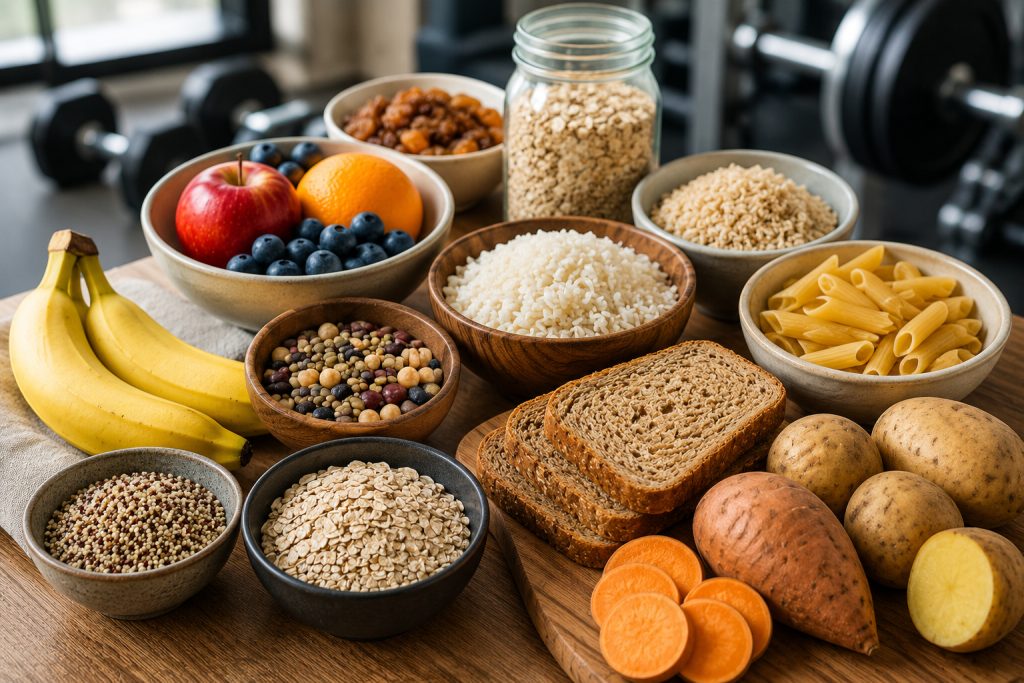
Good choices include rice, potatoes, oats, pasta, bread, cereals, fruit and legumes. Athletic Dieting’s food section similarly identifies cereals and their derivatives, legumes, potatoes and fruit among the major plant food groups relevant to dietary planning (Athletic Dieting – Foods).
The appropriate choice depends partly on timing. A high-fibre, slowly digested carbohydrate can be excellent several hours away from training, whereas a lower-fibre, easily digested source can be more convenient immediately before or after demanding exercise.
Glycemic index: do high-GI carbs build more muscle?
The glycemic index (GI) describes how quickly a carbohydrate-containing food raises blood glucose relative to a reference food. High-GI foods generally produce a faster rise in blood glucose and insulin than low-GI foods.
This has led to the popular idea that high-GI carbohydrates are superior for muscle growth because they produce more insulin. The reality is considerably more nuanced.
Insulin is an important anabolic hormone, and carbohydrate ingestion can reduce muscle protein breakdown. Nevertheless, when sufficient high-quality protein is consumed, carbohydrate does not appear to be necessary to produce the maximal stimulation of muscle protein synthesis after resistance exercise (Figueiredo & Cameron-Smith, 2013).

The GI may therefore be more relevant to exercise fueling and digestive tolerance than to hypertrophy itself (Athletic Dieting – Setting the pre-workout meal).
For resistance training specifically, there is no convincing evidence that choosing high-GI carbohydrates instead of low-GI carbohydrates directly produces more muscle hypertrophy.
The best carbohydrate foods for bodybuilding
For most people trying to gain muscle, the following foods make excellent carbohydrate staples:
- Rice: easy to digest, versatile and convenient for high-calorie diets.
- Potatoes: carbohydrate-rich and highly satiating, with useful vitamins and minerals.
- Oats: provide carbohydrate together with fibre and other nutrients.
- Pasta: energy-dense and practical when carbohydrate requirements are high.
- Bread and cereals: convenient ways to increase daily carbohydrate intake.
- Fruit: provides carbohydrate together with fibre, vitamins and minerals.
- Legumes: combine carbohydrate with fibre and a useful amount of protein.
The “best” carbohydrate is therefore not necessarily the one with the highest GI. The best carbohydrate is the one that allows you to consistently meet your nutritional requirements without causing digestive problems or making your diet unnecessarily difficult to follow.
When is the best time to eat carbohydrates for muscle growth?
Total daily carbohydrate intake is more important than obsessing over a precise carbohydrate “window.” Nevertheless, timing can be strategically useful.
Consuming carbohydrate before training can help ensure that glycogen and blood glucose availability are adequate. Carbohydrate intake after training promotes glycogen resynthesis, particularly when glycogen restoration must occur rapidly (Jentjens, Jeukendrup, 2003; Burke et al., 2017).
The importance of post-workout carbohydrate becomes particularly clear when another demanding session follows within a short period. A systematic review found that approximately 1.0 g/kg/h of carbohydrate during short recovery periods substantially increases the rate of glycogen resynthesis compared with water (Craven et al. 2021)
For a typical bodybuilding schedule with 24 hours or more between sessions, however, there is usually little reason to concentrate almost all carbohydrates immediately after training.
A sensible strategy is therefore to distribute carbohydrates across the day, with a substantial proportion around training when this improves energy, performance and recovery.
How many carbs does a bodybuilder need?
The answer depends on body weight, training volume, total energy expenditure, protein and fat intake, and the size of the desired calorie surplus.
For natural bodybuilders in the off-season, Iraki et al. (2019) recommend approximately 3–5 g/kg/day or more, depending on energy requirements and training demands. They recommend protein at approximately 1.6–2.2 g/kg/day, moderate fat intake, and using carbohydrates to supply the remaining energy requirements.
As a practical framework:
- ~3 g/kg/day: reasonable starting point for lower-volume training or individuals with relatively high fat requirements.
- ~3–5 g/kg/day: a useful general range for many bodybuilding phases.
- ~5 g/kg/day or more: potentially useful when training volume and total energy expenditure are particularly high.

These numbers should be treated as starting points rather than physiological requirements. If body weight, performance and recovery are not progressing, carbohydrate intake can be adjusted upward provided total calorie intake and other macronutrients remain appropriate.
How many carbs do bodybuilders eat?
There is no single carbohydrate intake shared by all bodybuilders. Competitive bodybuilders can consume substantially different quantities depending on body size, training volume and whether they are gaining muscle, maintaining weight or dieting.
During an off-season mass-gaining phase, a carbohydrate intake of 3–5 g/kg/day is a reasonable evidence-based starting range, with higher intakes appropriate for some high-volume athletes (Iraki et al., 2019).
The key is to avoid treating carbohydrates as an independent muscle-building substance. A high-carbohydrate diet is useful when it helps create an appropriate energy intake and supports training; simply increasing carbohydrate while ignoring protein, total calories or training quality is unlikely to produce additional hypertrophy.
High-carb diets for bodybuilding: pros and cons
A high-carbohydrate bodybuilding diet has several potential advantages. Carbohydrates efficiently replenish muscle glycogen, provide readily available energy for high-intensity exercise and can make it easier to consume sufficient calories during a mass phase (Holloszy & Kohrt, 1996)
They can also be particularly useful for athletes who perform high training volumes or multiple sessions.
There are disadvantages, however. A very high carbohydrate intake can make a diet unnecessarily large, may cause gastrointestinal discomfort in some individuals (Shi et al. 2004; Sereban et al. 2016, and can make it harder to control total calorie intake if carbohydrate-rich foods are consumed indiscriminately.
Most importantly, more carbohydrate does not automatically mean more muscle. The 2026 meta-analysis by Henselmans et al. (2026) found no significant independent hypertrophy advantage from higher carbohydrate intake when protein intake was controlled.
Do carbohydrates cause fat gain?
Carbohydrates are often blamed for increasing body fat because they stimulate insulin and can increase body weight rapidly through glycogen and water storage.
But increased scale weight after increasing carbohydrate intake is not equivalent to increased fat mass. Glycogen-associated water can substantially alter body weight and even measurements of lean mass (Schytz et al., 2023).
Fat gain during a muscle-building phase is primarily a consequence of sustained energy intake exceeding energy expenditure, rather than a unique property of carbohydrates. The metabolic fate of dietary carbohydrate includes oxidation and glycogen storage; conversion of carbohydrate into body fat through de novo lipogenesis is quantitatively limited under most ordinary dietary conditions (Jéquier, 1994).

Nevertheless, eating excessive carbohydrate can certainly contribute to fat gain if it causes a sufficiently large calorie surplus. This is why the size of the calorie surplus matters.
Iraki et al. (2019) recommend an off-season surplus of approximately 10–20% for novice/intermediate bodybuilders, with more conservative surpluses for advanced bodybuilders.
Protein vs carbohydrates: which matters more?
If the question is which nutrient is more directly important for building muscle, protein wins.
Resistance exercise stimulates muscle protein synthesis, and adequate dietary protein supplies the essential amino acids required to support the process. Morton et al. (2018), in a large systematic review and meta-analysis, found that protein supplementation enhances resistance-training gains in muscle mass and strength, with benefits tending to plateau around a total protein intake of approximately 1.6 g/kg/day in their dose-response analysis.
Carbohydrates play a different role. They are primarily a source of training fuel and help replenish glycogen. They can therefore support the process that produces hypertrophy without being the primary substrate from which new muscle protein is constructed.
For bodybuilding, the ideal approach is not “protein versus carbohydrates.” It is adequate protein, sufficient energy, appropriate fat intake and enough carbohydrate to support the training program.
Can you build muscle on a low-carb or ketogenic diet?
Yes, it is possible to gain muscle on a low-carbohydrate or ketogenic diet, provided that resistance training is effective, protein intake is adequate and energy intake is sufficient.
However, this does not mean that ketogenic diets are optimal for maximizing hypertrophy.
A systematic review and meta-analysis by Ashtary-Larky et al. (2021) found that ketogenic diets combined with resistance training were associated with lower body weight, fat mass and fat-free mass compared with non-ketogenic diets, although the interpretation is complicated by differences in energy intake and other dietary variables.
More specifically, Vargas-Molina et al. (2022) reviewed ketogenic diets in resistance-trained individuals and found no significant difference in fat-free mass between ketogenic and control diets, concluding that ketogenic diets can be an alternative when sufficient energy is consumed, but that adherence and satiety may limit their practicality.
A broader meta-analysis by Koerich et al. (2022) found that carbohydrate-rich diets tended to produce more favorable outcomes than ketogenic diets for free-fat mass and high-intensity performance, although the differences were not uniformly statistically significant.
Therefore, a ketogenic diet does not make muscle growth impossible, but there is currently little evidence that carbohydrate restriction provides an advantage for maximizing muscle hypertrophy.
The bottom line: how many carbs to build muscle?
So, how many carbs to build muscle? For most bodybuilders, starting around 3–5 g/kg of body weight per day is a sensible practical range, with higher intakes considered when training volume and energy expenditure are particularly high (Iraki et al. 2019).
Carbohydrates should not be viewed as a magic muscle-building nutrient, nor should increases in body weight after a high-carbohydrate diet be dismissed as nothing more than water. Carbohydrates replenish glycogen, support demanding resistance training and can contribute to an effective calorie surplus, while the water stored with glycogen explains part of the rapid increase in body weight and muscle fullness (Fernández-Elías et al. 2015)
At the same time, current evidence suggests that simply eating more carbohydrates does not independently increase hypertrophy when protein and other relevant factors are controlled (Hanselmans et al. 2026).
The most effective bodybuilding diet is therefore not necessarily the highest-carb diet. It is the diet that provides enough protein, enough energy, adequate fat, sufficient carbohydrate to support training, and a sustainable food pattern that can be maintained consistently over time.
Want to know more about sport nutrition?
Start reading the online manual from the beginning
You will learn:
- How to improve your body composition
- How to improve the quality of your post workout recovery
- How to assess the initial situation
- How to set the optimal caloric amount
- How to set the optimal ratio between macros
- What and how much to eat before, during and after workouts
- What and how much to eat before a peak performance or a race
- What the best food supplements are and how to take them
- Practice of diet planning
- And much more…