
General Guidelines
Knowing how many carbs before a workout can be useful for anyone who wants to optimize training performance, but there is no single carbohydrate dose that is ideal for every athlete or every workout. The appropriate amount depends on body weight, exercise duration and intensity, the time available for digestion, the athlete’s habitual diet, and the carbohydrate availability of the muscles and liver before exercise. This is consistent with the approach described in the pre-workout meal guide on Athletic Dieting, which emphasizes that the overall availability of glycogen is more important than simply following a rigid pre-workout meal formula.
For athletes who want to maximize performance during prolonged or high-intensity exercise, carbohydrate intake before training is generally useful because it contributes to maintaining high carbohydrate availability. The Academy of Nutrition and Dietetics, Dietitians of Canada, and American College of Sports Medicine recommend tailoring carbohydrate intake to the characteristics of the exercise session rather than applying one universal prescription (Thomas et al. 2016).
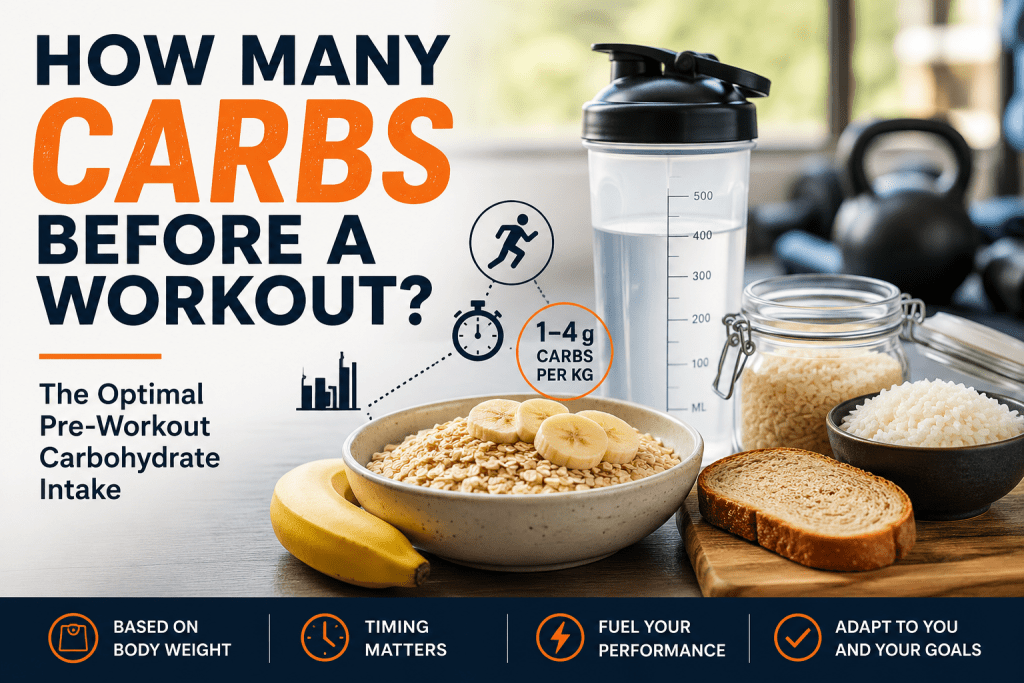
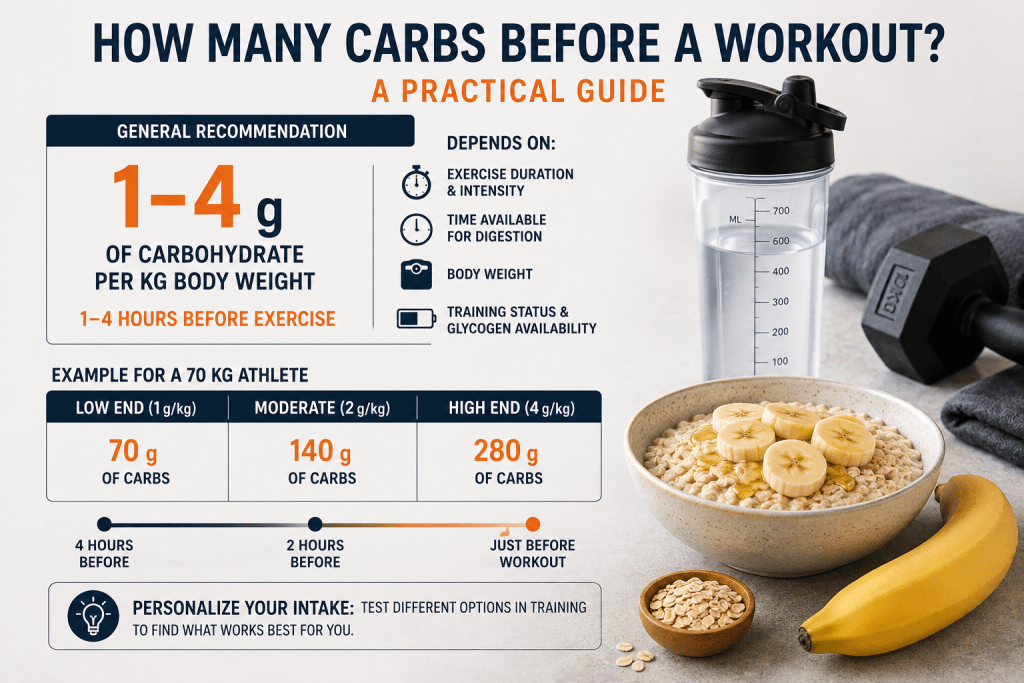
A widely used practical guideline is to consume approximately 1–4 g of carbohydrate per kilogram of body weight during the 1–4 hours before exercise. The higher end of this range is more appropriate when there is a long interval between the meal and exercise and when a substantial amount of carbohydrate is required, whereas smaller amounts are generally more practical when eating closer to training.
Importantly, these values should be considered a range rather than a mandatory target. A person performing a short, low-volume workout does not necessarily need the same carbohydrate intake as an endurance athlete preparing for several hours of demanding exercise.
Why Consume Carbohydrates Before a Workout?
Carbohydrates Provide an Important Exercise Fuel
Carbohydrates are stored in the body primarily as glycogen in skeletal muscle and the liver. During exercise, muscle glycogen and blood glucose can contribute substantially to energy production, particularly when exercise intensity is high. Increasing carbohydrate availability before exercise can therefore provide readily available substrate for working muscles.
This becomes particularly relevant during prolonged endurance exercise. Research has repeatedly demonstrated that carbohydrate availability can influence endurance performance, especially when exercise is sufficiently long or intense for carbohydrate stores to become an important limiting factor. Vandenbogaerde and Hopkins (2011), in a meta-analysis of acute carbohydrate supplementation studies, found that appropriately administered carbohydrate supplementation can produce meaningful improvements in endurance performance.
Carbohydrates Can Improve Training Performance
The benefits are not restricted to endurance athletes. A systematic review and meta-analysis by King, Helms, Zinn and Jukic (2022) found that acute carbohydrate ingestion can improve resistance-training performance, particularly by allowing athletes to complete a greater training volume. The effect was more evident in sessions lasting longer than 45 minutes and after fasting periods of eight hours or more.
This means that the answer to how many carbs do you need before a workout depends partly on what the workout actually demands. A long bodybuilding session, a high-volume martial arts practice, a hard interval session and a short technical workout do not necessarily require the same pre-workout carbohydrate strategy.
Carbohydrate Intake Is Especially Relevant After Several Hours Without Food
The importance of carbohydrate consumption may also increase when training takes place after a prolonged period without food. King et al. (2022) found that carbohydrate ingestion had a greater ergogenic effect on resistance-training performance when participants had fasted for at least eight hours.
This is one reason why a carbohydrate-containing meal can be particularly useful before morning training. It can help restore carbohydrate availability after the overnight fast, although the exact amount should still be adapted to the workout and the individual.
How Many Carbs Before a Workout?
A practical way to calculate the amount of carbohydrate for a pre-workout meal is:
Carbohydrate intake (g) = body weight (kg) × carbohydrate target (g/kg)
For most situations, a useful range is approximately 1–4 g/kg of body weight, consumed 1–4 hours before exercise. This range is consistent with established sports-nutrition recommendations.
How many carbs should I eat before a workout? The answer depends on body weight, the time available before exercise, and the demands of the session.
A Practical Example
Consider an athlete weighing 70 kg who plans to train approximately two hours after eating.
If the athlete chooses a target of 2 g/kg:
70 kg × 2 g/kg = 140 g of carbohydrates
The resulting pre-workout meal would therefore provide approximately 140 g of carbohydrate.
This does not mean that 140 g is necessarily the athlete’s optimal amount. It is simply the result of applying the formula. The appropriate value within the 1–4 g/kg range depends on the duration and intensity of the upcoming session, the amount of time available for digestion, previous meals and individual gastrointestinal tolerance.
For example, the same 70-kg athlete might use around 70 g of carbohydrate (1 g/kg) when eating relatively close to exercise, whereas a much larger intake could be considered when a substantial meal is consumed several hours beforehand.
More Carbohydrate Is Not Always Better

The objective of pre-workout carbohydrate intake is not to maximize the amount of carbohydrate consumed at all costs. It is to provide sufficient carbohydrate availability without creating unnecessary digestive discomfort or interfering with the overall dietary plan (Kerksick et al. 2022; Reynolds et al. 2022).
The research does not support the idea that every athlete should consume the upper end of the 1–4 g/kg range before every workout (Burke et al. 2011). Indeed, the pre-exercise carbohydrate literature includes considerable variation in dose, timing and exercise protocol (Reynolds et al. 2022). The appropriate strategy therefore needs to be individualized (Costa et al. 2025).
How Long Before a Workout Should You Eat Carbs?
The traditional recommendation is to consume the main pre-workout carbohydrate meal approximately 1–4 hours before exercise. This interval provides time for digestion and carbohydrate absorption while maintaining carbohydrate availability as exercise begins.
The amount can be adjusted according to the time available. A larger meal is generally easier to accommodate when several hours remain before training, whereas a smaller and more easily digested carbohydrate source may be preferable when exercise is approaching.
Four Hours Before Training
When approximately four hours are available, an athlete can generally tolerate a relatively substantial meal. Older controlled research has demonstrated that carbohydrate consumed four hours before prolonged cycling can influence carbohydrate metabolism and performance. For example, Sherman et al. (1989) found improved performance following a large carbohydrate feeding four hours before prolonged exercise.
One to Two Hours Before Training
When training begins one or two hours after eating, a moderate carbohydrate intake is often more practical. Carbohydrate consumed approximately one hour before prolonged exercise has also been shown to improve performance in controlled cycling studies.
Therefore, it is not necessary to avoid carbohydrates simply because exercise is approaching. A review by Jeukendrup and Killer (2010) specifically concluded that advice to avoid carbohydrate intake during the hour before exercise is unfounded, although some athletes may experience gastrointestinal or subjective symptoms and therefore require an individualized approach.
Very Close to Training
If only a short time remains before exercise, a smaller quantity of carbohydrate in an easily digestible form may be preferable to a large mixed meal. The closer the meal is to exercise, the more important individual tolerance becomes.
This is also consistent with the Athletic Dieting approach: the timing and composition of the pre-workout meal should be adapted to the individual rather than treated as an inflexible rule.
Best Sources of Carbohydrates for a Pre-Workout Meal
Rice, Pasta and Other Starchy Foods

Rice, pasta, potatoes, bread and other starch-rich foods can provide substantial amounts of carbohydrate and can work particularly well when eaten several hours before exercise. Their usefulness depends less on whether a food is traditionally labelled a “sports food” and more on its carbohydrate content, digestibility and the athlete’s tolerance.
Oats and Cereals
Oats and cereals can also be useful carbohydrate sources, particularly when consumed as part of a meal well before training. However, foods containing large amounts of fiber may not be ideal immediately before strenuous exercise for athletes who are prone to gastrointestinal discomfort.
Fruit
Fruit provides carbohydrate together with water, vitamins, minerals and, depending on the type, varying amounts of fiber. Bananas, grapes and other relatively easy-to-digest fruits can therefore be convenient choices before training.
Sports Drinks and Easily Digested Carbohydrates
When there is little time between eating and exercise, liquid carbohydrate sources or other rapidly digestible foods can be practical. This can be particularly useful when a conventional meal would feel too heavy.
There is no strong evidence that athletes should systematically choose either low- or high-glycemic-index carbohydrate sources before exercise. Wong et al. (2017) found a statistically significant advantage for low-glycemic-index meals in their meta-analysis, but rated the available evidence as weak because all included studies were of low methodological quality. Similarly, Burdon et al. (2017) found no clear performance benefit of low-glycemic-index meals. Therefore, the glycemic index of the pre-workout carbohydrate source should not be considered a decisive factor for most athletes.
Consequently, the best carbohydrate source is often the one that provides the required amount of carbohydrate while being well tolerated and compatible with the timing of the workout.
Common Mistakes to Avoid With Pre-Workout Carbohydrates
Eating Too Much Simply Because More Carbohydrate Seems Better
One of the most common mistakes is interpreting the 1–4 g/kg recommendation as an instruction to always eat 4 g/kg. The range is intended to accommodate different circumstances, not to establish a universal optimum. Excessive food intake can create unnecessary digestive discomfort and can also make it harder to maintain the desired total daily calorie intake.
Eating a Large Meal Too Close to Exercise
A large meal immediately before training may increase the likelihood of gastrointestinal discomfort. The digestive system and working muscles compete for physiological resources during exercise, and gastrointestinal symptoms are a recognized practical concern in sports nutrition.
The solution is not necessarily to eliminate pre-workout food, but rather to adjust meal size, composition and timing.
Focusing Only on the Glycemic Index

Another mistake is assuming that high-glycemic carbohydrates are always superior before exercise or, conversely, that low-glycemic carbohydrates are always preferable.
Research comparing high- and low-glycemic pre-exercise meals has produced inconsistent results. Wong et al. (2017) reported a possible advantage for low-glycemic meals, but characterized the evidence as weak, while Burdon et al. (2017) found no clear overall benefit.
For most athletes, the quantity of carbohydrate, timing, digestibility and individual tolerance are more useful practical considerations than rigidly selecting foods according to glycemic index.
Ignoring the Rest of the Diet
A pre-workout meal cannot compensate indefinitely for inadequate carbohydrate intake throughout the rest of the day. Burke et al. (2011) emphasized that carbohydrate availability depends on both total carbohydrate intake and its timing relative to exercise.
For athletes undertaking demanding training, therefore, the pre-workout meal should be considered part of the overall nutritional strategy rather than an isolated nutritional trick.
Assuming Carbohydrates Are Necessary Before Every Workout
Finally, carbohydrate intake before training is a tool, not a requirement for every exercise session. The benefit is likely to be greater when carbohydrate availability is important for the planned activity, particularly during prolonged or high-intensity exercise or after a prolonged fast.
For shorter or less demanding sessions, the additional carbohydrate may provide little practical benefit, especially if the athlete has already eaten adequately during the preceding hours.
Summary: How Many Carbs Before a Workout?
The optimal answer to how many carbs before a workout is individual rather than universal. A useful evidence-based starting point is 1–4 g of carbohydrate per kilogram of body weight during the 1–4 hours before exercise, with the appropriate amount depending on exercise demands, timing, previous food intake and gastrointestinal tolerance.
For example, a 70 kg athlete choosing 2 g/kg would consume approximately 140 g of carbohydrate before training. The closer the meal is to exercise, however, the more important it becomes to control meal size and choose easily tolerated foods.
Carbohydrates are particularly useful when training is prolonged, intense, high-volume or performed after a long period without food. Evidence also indicates benefits for resistance-training volume in demanding sessions, especially after prolonged fasting.
Ultimately, the best pre-workout carbohydrate strategy is not the one that follows the largest possible number on a formula. It is the one that provides adequate carbohydrate availability while allowing the athlete to begin training comfortable, well-fuelled and ready to perform.
Want to know more about sport nutrition?
Start reading the online manual from the beginning
You will learn:
- How to improve your body composition
- How to improve the quality of your post workout recovery
- How to assess the initial situation
- How to set the optimal caloric amount
- How to set the optimal ratio between macros
- What and how much to eat before, during and after workouts
- What and how much to eat before a peak performance or a race
- What the best food supplements are and how to take them
- Practice of diet planning
- And much more…